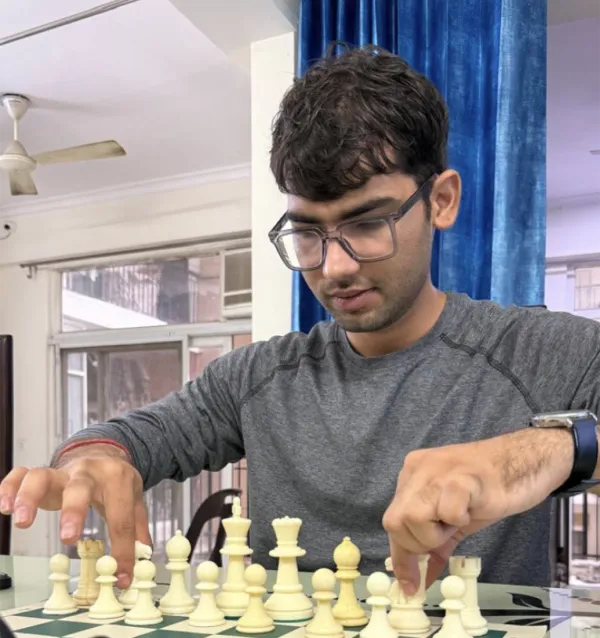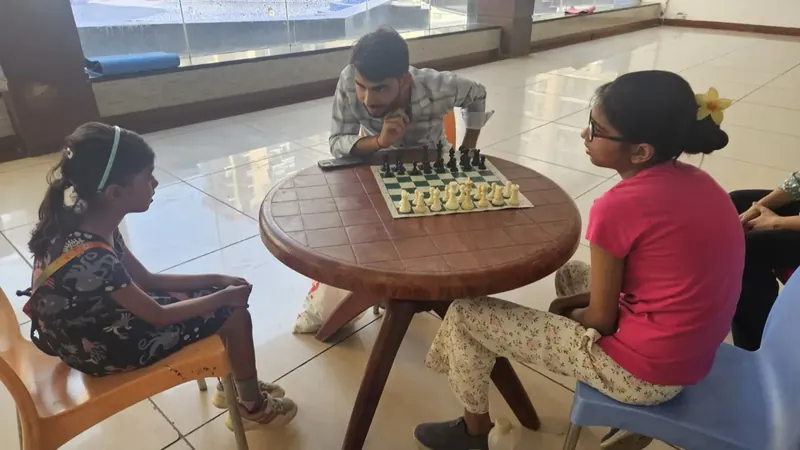
Every parent wants their child to succeed academically. But what if one of the most powerful tools for better grades isn't a tutor, a textbook, or a learning app — it's a chessboard?
As a FIDE Rated chess coach who has worked with hundreds of students aged 5–18, I've watched chess transform not just how children play — but how they think. Here are seven research-backed ways chess directly improves academic performance.
1. Chess Builds Mathematical Thinking
Chess is, at its core, a game of patterns and logic. Every move requires a student to calculate forward: if I move here, what happens next? And after that?
This is precisely the kind of sequential reasoning that mathematics demands. Studies from Venezuela, New Brunswick, and the City of New York have all found statistically significant improvements in math test scores among children who receive chess instruction as part of their curriculum.
"Chess is not just a game. It is a language of math — one where every move is an equation." — Chirag Soni, Head Coach
At TheChessLifestyle, our curriculum is structured to explicitly connect chess patterns to mathematical thinking: counting material, calculating probability of captures, and recognising geometric patterns on the board.
2. Chess Dramatically Improves Concentration
In a world of 8-second attention spans, chess is a radical act. A single chess game requires sustained, unbroken focus for 20 to 90 minutes.
Children who play chess regularly develop what psychologists call executive attention — the ability to focus deliberately on a task while filtering out distractions. This skill directly transfers to classroom learning, where sitting through a 45-minute lesson is a prerequisite for learning anything at all.
Within three months of consistent coaching, most of our students show measurably improved classroom focus, according to parent feedback we collect at the 90-day mark.
3. Chess Teaches Critical Thinking and Problem Solving
Every chess position is a unique problem with no pre-set answer. Children must analyse the situation, generate candidate solutions, evaluate trade-offs, and decide under time pressure.
This is the definition of critical thinking — and it is one of the most sought-after skills in the 21st-century classroom and workplace. Unlike multiple-choice exercises, chess never gives you a hint. You must figure it out yourself.
What this looks like in our classes:
- Students are asked to find the best move in a given position before being told the answer
- They must explain why their move is best (verbalising reasoning)
- They then evaluate what would happen if they were wrong (consequence mapping)
4. Chess Develops Reading Comprehension
This one surprises most parents. What does chess have to do with reading?
A study by Dr. Stuart Margulies found that children who studied chess scored significantly higher on the Degrees of Reading Power test than non-players. The connection is indirect but real: chess requires children to "read" the board — interpreting complex patterns, understanding intent, and constructing narrative sequences (what happened, what's happening, what will happen).
These are the exact cognitive skills needed to comprehend a paragraph, understand a character's motive in a story, or follow an argument in a textbook.
5. Chess Builds Memory and Pattern Recognition
Chess grandmasters can recognise up to 100,000 different board patterns — stored in long-term memory through years of deliberate practice. Even beginners rapidly develop pattern libraries: common opening sequences, tactical motifs like forks and pins, and endgame techniques.
This trains the memory in a way that rote learning cannot — because chess memory is meaningful memory. Children remember patterns because they matter in the game. This active, motivated memory practice strengthens the hippocampus and improves general memory performance across subjects.
6. Chess Teaches Children to Handle Failure Gracefully
Every chess player loses. A lot.
Even world champions lose games. What separates great chess players isn't that they never lose — it's that they analyse their losses and come back stronger. We explicitly teach this at TheChessLifestyle: after every loss, students review their games and identify the exact moment things went wrong.
This builds resilience, emotional regulation, and a growth mindset — the understanding that failure is data, not defeat. These traits are foundational for academic success and for life.
7. Chess Improves Creativity
Chess is often thought of as purely logical. But great chess is deeply creative. The most celebrated chess games in history involve breathtaking sacrifices, unexpected manoeuvres, and ideas that defy convention.
Students who study chess learn to generate unusual ideas, think outside established patterns, and approach problems from unexpected angles. This creativity transfers to essay writing, science projects, and artistic work.
How to Get Started
If you're considering chess coaching for your child, here's what I recommend:
- Start early — Children as young as 5 can learn the rules and begin pattern recognition training
- Be consistent — Two sessions per week for six months produces dramatic results
- Choose a qualified coach — Look for FIDE Rated coaches who specialise in children's instruction (not just strong players)
- Make it fun — The best chess students are the ones who love the game
At TheChessLifestyle, we offer a completely free 45-minute trial class for every new student — no credit card, no commitment. You'll see the difference after just one session.
The Bottom Line
Chess is not a luxury activity for academically gifted children. It is a training system for the mind — one that builds the foundational cognitive skills every child needs to succeed: focus, memory, problem-solving, resilience, and creativity.
The chessboard is, arguably, the most powerful learning tool ever invented. And the best time to start is now.