How Every Chess Piece
Moves — In Plain English
Before you can play, you need to know your army. Here's a plain-English guide to every piece — no jargon, no diagrams full of arrows.
The King — Your Most Important Piece
Moves 1 square in any direction — up, down, sideways, or diagonally. The King can never move into a square where it would be captured. Losing the King = losing the game.
The King also participates in castling — a special move we'll explain below.
Priceless — protect at all costsThe Queen — Your Powerhouse
Moves any number of squares in any direction — horizontal, vertical, or diagonal. The most powerful piece on the board. Beginners often lose their queen early by moving her out too soon.
Tip: Keep your queen safe in the opening. Don't bring her out before your other pieces.
Worth 9 pointsThe Rook — The Open File Monster
Moves any number of squares horizontally or vertically — like a "+" sign. Rooks are most powerful in the endgame when the board is open. Two rooks on the 7th rank can be devastating.
Rooks also participate in castling with the King.
Worth 5 pointsThe Bishop — The Diagonal Sniper
Moves any number of squares diagonally. Crucially, each Bishop stays on its own colour for the entire game — one always on white squares, one on black. A good bishop needs open diagonals to shine.
Two bishops together are called the "Bishop Pair" and are very powerful in open positions.
Worth ~3 pointsThe Knight — The Only Jumper
Moves in an L-shape: 2 squares in one direction, then 1 square perpendicular. The Knight is the only piece that can jump over other pieces. This makes it uniquely powerful in closed positions where other pieces are blocked.
Knights are tricky for beginners — practice visualising the L-shape on a real board.
Worth ~3 pointsThe Pawn — The Soul of Chess
Moves forward 1 square (or 2 from its starting position). Captures diagonally forward — not straight ahead. Pawns cannot move backward. When a pawn reaches the opposite end of the board, it promotes to any piece — almost always a Queen.
Grandmaster Savielly Tartakower said: "The pawns are the soul of chess."
Worth 1 pointWhat Every Beginner Needs
to Know Before Move 10
These aren't optional tips — they're the difference between a beginner who improves and one who keeps losing the same way.
Control the Centre
The four central squares (e4, d4, e5, d5) are the most valuable real estate on the board. Pieces placed near the centre control more squares and are more active. Open with 1.e4 or 1.d4 to claim the centre immediately.
Develop Your Pieces Early
Get your knights and bishops off the back rank within the first 5–7 moves. Every piece sitting on its starting square is a piece not helping you. A developed army is a winning army. Avoid moving the same piece twice in the opening.
Castle Early — Keep Your King Safe
Castling tucks your King to the side of the board, behind a wall of pawns, and connects your rooks. Most beginners castle too late and get their King caught in the centre during a middlegame attack. Aim to castle before move 10.
Your coach will drill these 3 rules in your very first session. Students who master these principles consistently beat opponents who've been playing longer but never learned the fundamentals.
The 3 Special Rules You Must Know
These confuse most beginners — but once you know them, you'll never be surprised again.
Castling
The King moves 2 squares toward a Rook, and the Rook jumps to the other side. You can castle if: neither piece has moved, no pieces are in between, and the King is not in check. It's the only move where two pieces move at once.
En Passant
If a pawn moves 2 squares from its starting position and lands beside your pawn, you can capture it "in passing" — as if it had only moved 1 square. This capture must happen immediately on the very next move, or the right is lost forever.
Pawn Promotion
When your pawn reaches the opposite end of the board (the 8th rank for White, 1st rank for Black), it must immediately become another piece. You can choose a Queen, Rook, Bishop, or Knight — almost always choose the Queen.
The 4 Tactical Patterns
Every Beginner Must Learn
Chess tactics are short sequences of moves that win material or checkmate. These four patterns appear in almost every beginner game — knowing them means you win them, not lose them.
The Fork
One piece simultaneously attacks two enemy pieces. Your opponent can only save one — you win the other. Knights are the best forking pieces because of their unique L-shaped movement.
Example: A knight on e5 simultaneously attacks a rook on c6 and a bishop on d3. Your opponent loses material no matter what they do.
Most common beginner tacticThe Pin
A piece is "pinned" when it cannot move without exposing a more valuable piece behind it. A pinned piece is paralysed — it's defending the piece behind it, not playing its own role.
Example: A bishop on b5 pins a knight on c6 against the opponent's king. The knight cannot move without exposing the king to check.
Bishops & Rooks execute bestThe Skewer
The reverse of a pin. A more valuable piece is attacked directly; when it moves to safety, the less valuable piece behind it is captured. Think of it as "shooting through" the front piece to hit the back piece.
Example: A rook attacks the king (in check). The king must move, leaving a queen behind on the same file — which the rook then captures.
Rooks & Queens excel hereDiscovered Attack
Moving one piece reveals an attack from another piece behind it. The moved piece creates its own threat while the revealed piece creates a second threat — two attacks from one move.
Example: Moving a knight reveals a bishop's diagonal, attacking the queen. Opponent must deal with the queen threat and loses the piece the knight just captured.
Deadly when set up correctlyIn your first few sessions, your coach will show you these 4 patterns in real positions. Recognising them on the board is a skill — it comes from practice, not just reading about them.
Practice These With a FIDE Coach →What Does a Beginner's
Progress Actually Look Like?
Real, honest timelines from our coaches — based on students who study 1 session/week plus 15 minutes of daily puzzles.
Week 1–2
You know how all pieces move. You understand check, checkmate, and stalemate. You've played your first real game — and enjoyed it, even if you lost.
Sessions 1–2Month 1
You know the special rules (castling, en passant). You can spot simple forks and back-rank threats. You've stopped blundering your queen in the first 5 moves.
Sessions 3–6Month 2–3
You have a clean opening repertoire. Your Chess.com rating is climbing past 700–900. You're winning games against other beginners regularly.
Sessions 7–14Month 4–6
Rating 900–1200 on Chess.com. You understand basic endgames (King + Pawn). You've played in your first internal tournament and won matches.
Sessions 15–24* Timelines vary by student age, consistency, and puzzle practice. Kids often progress faster with our story-based 0-Level curriculum.
Why Beginners Learn Faster
With a Coach Than an App
Apps are great for practice. But they can't correct your thought process, explain why you blundered, or adapt the lesson when you're confused. That's what coaches do.
FIDE-Rated Coaches Only
Every instructor has a verified FIDE rating and competes at national level. You're learning from someone who has actually played competitive chess — not a hobbyist or an algorithm.
Structured Beginner Curriculum
We don't throw random lessons at you. Every session builds on the last — from piece movements, to tactics, to openings, to endgames — following a clear roadmap designed for beginners.
Post-Game Analysis
After every session your coach reviews your most recent games — pointing out exactly where you made mistakes and what the correct thinking process should have been. Apps can't do this.
CRM Parent Dashboard
Parents see exactly what was taught each session, what homework was set, and how rating is progressing — all inside our in-house CRM. No guessing what "they practised chess today" means.
In-House Beginner Tournaments
Regular internal tournaments where beginners play other beginners — a safe, pressure-free environment to experience competitive chess before entering rated events.
Your Timezone, Your Schedule
EST, GMT, GST, AEDT — we schedule sessions at times that work for your life, not ours. Weekend mornings, weekday evenings — we cover all timezones for students in USA, UK, Canada, Australia, UAE and beyond.
The FIDE-Rated Coaches Who
Will Teach You Chess
Our coaches love teaching beginners. Watching someone go from "what does a knight do?" to winning their first tournament is the most rewarding thing in chess education.
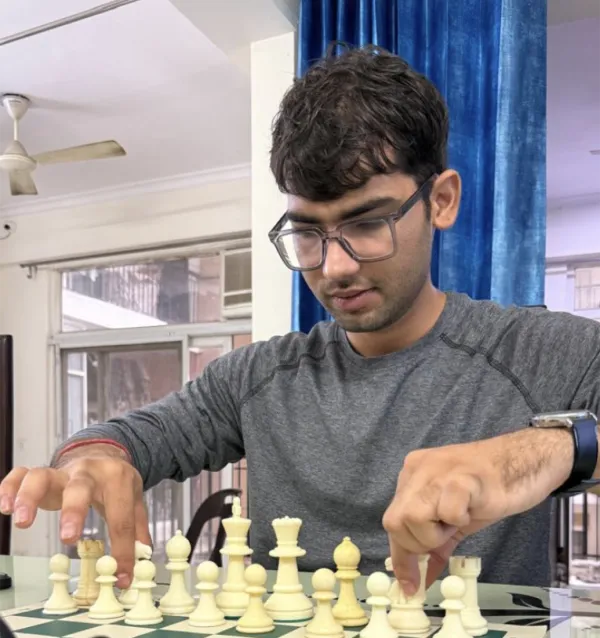
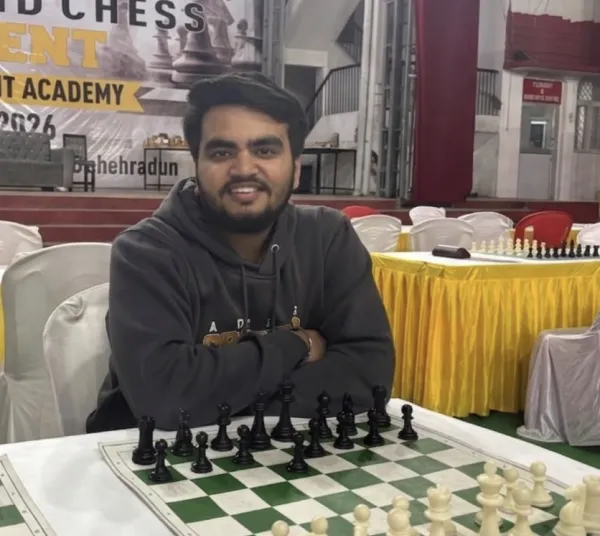

Ankush
7 years coaching
Chess.com 1630 —

From "I Don't Know the Pieces"
to School Champion
These are the students we love most — complete beginners who committed to weekly coaching and surprised everyone, including themselves.
"My son literally didn't know what a pawn was when we started. After 3 months of weekly sessions with Coach Chirag, he won the U-12 chess championship at his school in Dallas. I'm still in shock — but the coaches are genuinely that good."
"I was a 34-year-old complete beginner — a bit embarrassed to admit I didn't know how the knight moved! Coach Yash was incredibly patient. Six months later, my Chess.com rating is 1100 and I've beaten players who've played for years."
"My 6-year-old was sceptical about 'video call classes' but within the first session she was completely hooked. She loves how Coach Chirag makes the pieces feel like characters in a story. Her focus in school has improved noticeably too."
Everything a Beginner
Wonders About Chess
Straight from our coaches — no fluff, no jargon. If you have a question not answered here, ask during your free trial.
Place the board so there's a white square in the bottom-right corner (remember: "white on right"). The back row from left to right is: Rook, Knight, Bishop, Queen, King, Bishop, Knight, Rook. The Queen always goes on her own colour — white queen on a white square, black queen on a black square. Pawns fill the entire second row. In your very first trial session, your coach will walk you through the setup live on a shared Lichess board — no need to memorise this beforehand.
Check means your King is being attacked by at least one enemy piece. You must deal with it on your next move (by moving the King, blocking the attack, or capturing the attacking piece). You cannot make any other move while in check. Checkmate means your King is in check and you have absolutely no legal move to escape — that's the end of the game. Stalemate is different: your King is not in check, but you have no legal moves at all — the game is a draw. Recognising the difference between checkmate and stalemate is important because delivering stalemate accidentally when you're winning is a beginner's heartbreak.
We recommend beginners start with principle-based openings rather than memorised sequences: (1) The Italian Game (1.e4 e5 2.Nf3 Nc6 3.Bc4) — controls the centre, develops pieces quickly, prepares castling. (2) The London System (1.d4 2.Bf4 3.e3 4.Nf3) — very solid, hard for opponents to surprise you. (3) The Caro-Kann (1.e4 c6) — a solid reply to e4 for Black. But more importantly, our coaches teach you the principles behind these openings: control the centre, develop your pieces, don't move the same piece twice, castle early. Once you understand the principles, the specific moves follow naturally.
The #1 cause of beginner losses is moving without checking if any pieces are being attacked. Before every move, build this habit: ask yourself "Is any of my pieces under attack?" and "Does my opponent have any threats I haven't seen?" This 5-second check — called a blunder check — eliminates 80% of beginner mistakes. The other common mistake is leaving pieces undefended (hanging pieces). Count your pieces before and after each move mentally. Our coaches drill this habit from the very first session using real game positions.
On Chess.com, complete beginners typically start at 400–600. After 1–2 months of regular play: 600–800. After 3–6 months of coached study: 900–1200. On Lichess (slightly higher ratings than Chess.com), add about 100–200 points to these numbers. Don't fixate on rating in the first 3 months — focus on learning the 4 basic tactics and 3 opening principles. Rating improvement follows naturally from understanding, not from playing more games randomly. The fastest rating gain comes from post-game analysis — reviewing your mistakes with a coach after every session.
Tactics first — always. Here's the truth: a memorised opening is useless if your opponent does something unexpected on move 4. But understanding forks and pins lets you win material in any position. Our coaches teach all beginners tactics for the first 4–8 weeks before introducing opening theory. By the time you learn your first opening, you'll understand the tactical ideas that make it work — rather than just memorising moves that feel random. This is the approach used by every professional coach worldwide, and it's why our students improve 3–5x faster than self-taught players.
Both — they serve different purposes. Apps (Chess.com, Lichess) are excellent for practice volume — playing games, solving puzzles, building speed. But apps cannot watch you think, notice when you're calculating shallowly, or explain why a position is good or bad in a way that corrects your mental process. Live coaching is where the learning happens. Our recommendation: attend 1 weekly live session with a coach + do 15–20 minutes of puzzles daily on Chess.com or Lichess. This combination accelerates improvement dramatically faster than either alone.
Classes run live on Zoom with a shared chessboard on Lichess (no download needed — it's browser-based). Your FIDE-rated coach explains concepts on screen, moves pieces live, and gives you positions to solve in real time. Each 45-minute session covers one focused topic (e.g., "understanding forks" or "the Italian Game"). After every class, your coach submits a detailed progress report and a homework puzzle set — visible in our parent CRM portal. You always know exactly what was taught and what to practise before next session.
Genuinely no catch. 100% free — no credit card required, no automatic billing, no commitment to continue. You get a full 45-minute live session with a FIDE-rated instructor who will teach you the basics of chess (or assess your existing level), explain how our curriculum works, and answer all your questions. If you decide not to continue after the trial, that's completely fine. We'd rather you try it and not continue than never try at all. We confirm your slot within 24 hours of booking.
5 is actually a perfect age to start. Young children absorb patterns effortlessly — the same ability that makes them pick up languages quickly also makes them exceptional at tactical pattern recognition in chess. Our 0-Level curriculum for ages 5–8 uses story-based learning: the King is a character, each piece has a personality and a movement story. Sessions are short, playful, and full of mini-games. Most 5-year-olds can learn all piece movements in 2–3 sessions. Their proudest moment? Announcing "checkmate" for the first time — usually during the trial class itself.
Looking for Something
More Specific?
Dedicated pages for every age group, country, and goal.
Ready to Start Your
Chess Journey?
Book a Free Class.
Whether you're a complete beginner, a parent enrolling a 5-year-old, or an adult picking up chess for the first time in 30 years — you're in the right place. Our coaches have seen every kind of beginner. They know exactly how to make it click for you.
- 100% free — no credit card required
- 45-min live session with a FIDE-rated coach on Zoom
- Absolute beginners get a piece-by-piece introduction
- Personalised level assessment + curriculum roadmap
- Confirmed within 24 hours • Timezone-matched
After the trial, classes start from
₹3,999/month · ~$50 USD · ~£38 GBP
View full pricing & discounts →
Book Your Free Beginner Trial
We'll confirm your slot within 24 hours